

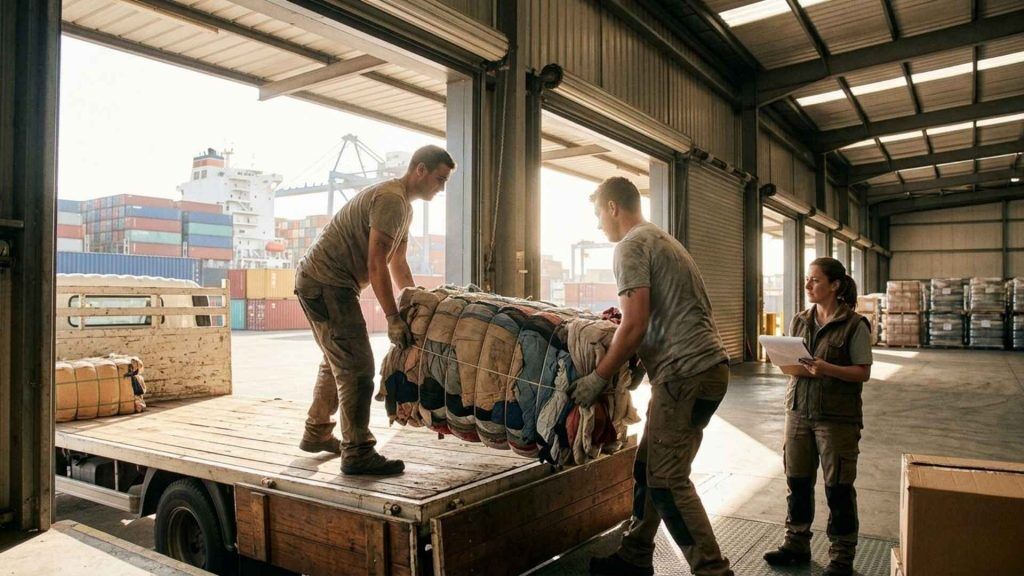
The global market for used clothing exports is booming. Resale hubs across Africa, the Middle East, and Asia are absorbing billions of dollars in second-hand garments annually. But behind every successful shipment is a document detail most exporters underestimate: the Harmonized System (HS) code.
Get it right — your cargo clears smoothly. Get it wrong — customs holds, reclassification fees, and shipment delays begin stacking up before the container even reaches the destination port.
Primary HS code for worn clothing & worn articles
HS Chapter covering all made-up textile articles
Countries with strict import rules for used textiles
Average delay caused by incorrect HS classification
What Are HS Codes in International Shipping?
HS (Harmonized System) codes are internationally standardized numerical codes used to classify goods in global trade. Administered by the World Customs Organization, they appear on every commercial invoice, bill of lading, and export declaration.
Key fact: HS codes directly determine customs duties, VAT treatment, import restrictions, and whether your cargo triggers a physical inspection at the destination port.
For used clothing exports, classification depends on multiple factors — condition of garments (wearable vs. textile waste), material composition, sorting level, and the specific import regulations of the destination country.
Why HS Codes Are Critical in Used Clothing Exports
⚠ Impact of Incorrect HS Code — Risk Level by Consequence
3.1 — Customs Duties & Taxes
Incorrect classification means wrong duty rates get applied. Importers face unexpected landed costs — buyers who absorb those charges rarely re-order. Your pricing model breaks before the bale is even opened.
3.2 — Customs Delays
Customs authorities match HS codes against cargo descriptions. A mismatch — even a minor one — triggers document checks, physical inspections, and demurrage charges. A 5-day delay can cost a buyer a full sales season.
3.3 — Destination Country Compliance
Countries across Africa, the Middle East, and Asia have specific import rules for used textiles. HS codes are the first filter customs uses to determine whether your cargo needs fumigation certificates, special permits, or is outright restricted.
3.4 — Document Accuracy
Your HS code must match the commercial invoice, packing list, bill of lading, and export declaration — exactly. Any mismatch is a red flag that can pause clearance until an amendment is filed.
Common HS Code Classifications for Used Clothing
Common mistake: Classifying sorted, wearable second-hand garments under textile waste codes (6310) instead of worn clothing codes (6309) can result in cargo being treated as refuse — triggering rejection in markets like Kenya, Ghana, and the UAE.
4 Key HS Code Challenges in Used Clothing Exports
Mixed Bales
Shirts, pants, shoes, and accessories in one container complicate single-code classification.
Destination Variance
A code accepted in Nigeria may be questioned in Pakistan. Rules differ country to country.
Waste vs. Wearable
Classifying reusable garments as textile waste causes rejection and damages seller credibility.
Vague Descriptions
“Used clothes” is not enough. Authorities want condition, category, and material specifics.
Where HS Codes Must Be Accurate
Best Practices for HS Code Accuracy
Used Clothing Exports — Key Markets & Compliance Notes
Common Mistakes to Avoid
How Freight Forwarders Reduce HS Code Risk
A specialist freight forwarder working in used clothing exports does more than book a container. They act as your documentation layer — reviewing HS codes, aligning cargo descriptions across all documents, coordinating with customs brokers, and flagging destination-specific requirements before your cargo leaves the warehouse.
GFF Canada provides dedicated logistics support for used clothing exporters shipping to Africa, the Middle East, and Asia — including customs documentation review, container booking, and end-to-end compliance support. Learn about our used clothing export services →
Conclusion
In the competitive world of used clothing exports, HS codes are not bureaucratic formality — they are the numeric language that customs authorities use to decide whether your cargo moves or stops.
Correct classification protects your cost structure, your delivery timeline, and your buyer relationships. Confirm codes early. Keep every document aligned. Work with a logistics partner who knows the destination rules before problems arise — not after a hold is issued.
📚 Related Reading
→ How to Reduce Global Used Clothing Shipping Costs
→ GFF Canada — Used Clothing Export Logistics Services
→ Straight Truck & Inland Freight Solutions — NFFI
→ GFF Canada — International Freight Forwarding
Ready to Ship Without the Customs Headaches?
Avoid customs delays, unexpected charges, and documentation errors. Partner with a logistics team that specializes in used clothing exports worldwide.

