

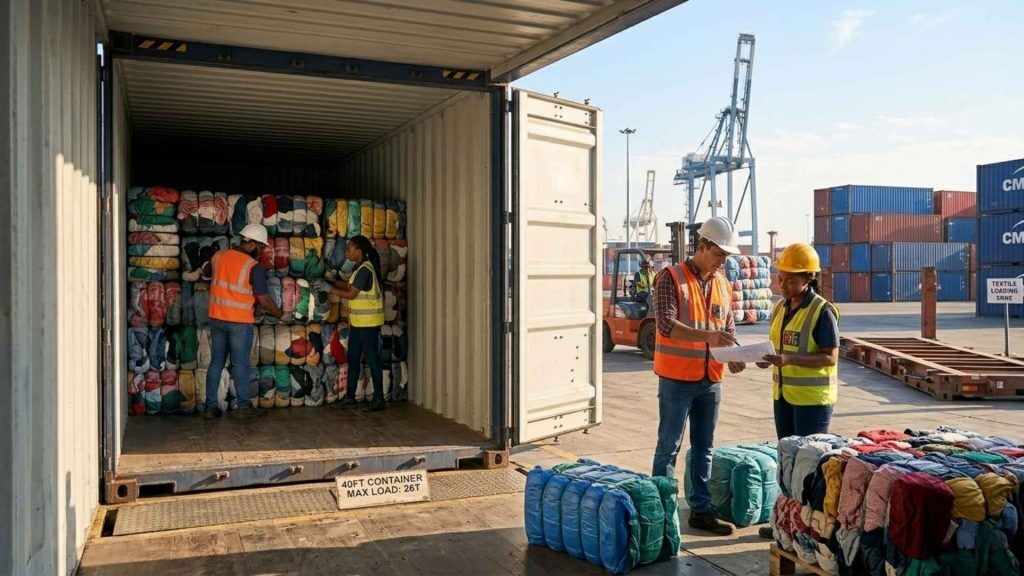
The global used clothing shipping market is booming—projected to reach $218 billion in 2026. But here’s the problem: exporters are caught in a vice between rising freight costs and razor-thin margins. Cut costs the wrong way, and you’ll face rejected containers, customs penalties, and destroyed buyer relationships.
This guide shows you how to reduce shipping costs by 20-35% without sacrificing the quality standards that keep your buyers coming back. We’re talking real strategies from the trenches—not generic advice that sounds good but fails in practice.
Understanding Your True Cost Structure
Before you can optimize, you need to know where your money actually goes. Here’s the breakdown most used clothing exports businesses are working with:
| Cost Component | % of Total Cost | Optimization Potential |
|---|---|---|
| Procurement & Sourcing | 30-35% | High |
| Sorting & Grading | 15-20% | Medium |
| Packaging & Baling | 8-12% | High |
| Inland Transportation | 5-8% | High |
| Ocean Freight | 25-30% | Medium |
| Port & Destination Charges | 10-12% | High |
Key insight: Ocean freight is your biggest line item, but it has medium optimization potential. The real savings? They’re in procurement, packaging, and avoiding unnecessary charges—areas with high control.
Why Quality Directly Impacts Your Bottom Line
Here’s what happens when you sacrifice quality to cut costs:
- 6% average customs rejection rate for improperly graded shipments
- $2,500-$8,000 per container in claims and reshipment costs
- Loss of repeat business—buyers who receive inconsistent quality don’t come back
- Contamination penalties—unsorted bales with 8-12% contamination vs. 2-4% for properly graded
The math is simple: one rejected container wipes out the savings from 10-15 optimized shipments. Quality isn’t a luxury—it’s cost control.
Strategy 1: Optimize Sourcing Without Compromising Standards
Smart sourcing isn’t about finding the cheapest suppliers. It’s about predictable quality at scale.
What works:
- Build 2-3 core supplier relationships instead of chasing spot deals. Long-term partners give you priority access and better per-unit pricing
- Bulk purchasing locks—commit to monthly volumes for 8-12% discounts without quality compromise
- Quality audits upfront—invest 2-3 hours inspecting supplier processes. Saves 20+ hours in re-sorting later
- Seasonal timing—source winter clothing in summer months when prices drop 15-25%
Real-world example: A Toronto exporter switched from 8 irregular suppliers to 3 vetted partners. Result? 18% cost reduction and sorting time cut by 40%.
Strategy 2: Transform Your Sorting & Grading Efficiency
This is where most exporters leak money. Inefficient sorting means paying workers longer and generating more waste.
| Quality Tier | Market Share | Avg Price/kg | Sorting Time |
|---|---|---|---|
| Premium/Vintage | 5-10% | $8-12 | High |
| Sorted/Graded (A/B) | 40-50% | $2-4 | Medium |
| Unsorted Bales (Mixed) | 40-45% | $0.50-1.50 | Low |
Optimization tactics:
- Create visual grading guides with photo examples. New workers reach full speed 60% faster
- Time-box sorting sessions—workers sort faster when working in focused 90-minute blocks
- Separate sorting lines by tier—dedicated teams for Premium vs. Unsorted reduces cross-contamination
- Track waste percentage—if you’re discarding more than 12%, your sourcing needs work
Strategy 3: Maximize Packaging & Bale Efficiency
Standardized bales are the secret to container utilization rates above 92%. Here’s the benchmark:
Optimal bale specifications:
- Weight: 45-50kg per bale (standard for most markets)
- Dimensions: 100cm x 80cm x 60cm (maximizes stacking)
- Compression: High-density baling reduces volume by 40-50%
- Wrapping: Double-layer plastic film prevents moisture and contamination
Cost impact: Proper baling gets you 520-580 bales per 40ft container vs. 380-420 for poorly compressed loads. That’s 30-35% more product per shipment.
Strategy 4: Master Container Utilization
This is where amateur exporters throw away money. Compare these scenarios:
| Loading Method | Bales per 40ft | CBM Utilization | Cost per Bale |
|---|---|---|---|
| Poor Loading | 380-420 | 72-78% | $6.80 |
| Optimized Loading | 520-580 | 88-95% | $4.90 |
| Savings per Container | +150 bales | +17% | -$1.90/bale |
Smart stacking techniques:
- Load heavy bales (winter coats, jeans) at bottom
- Fill gaps with smaller premium bales
- Use “tetris method”—rotate bales to eliminate dead space
- Measure and weigh before loading—don’t estimate
For expert container loading strategies, consider working with specialists in warehousing and distribution who optimize every cubic meter.
Strategy 5: Choose the Right Shipping Mode
FCL (Full Container Load) vs. LCL (Less than Container Load)—when does each make sense?
| Shipping Mode | Best For | Cost Range | Transit Time |
|---|---|---|---|
| FCL (40ft Container) | 15+ tons / 500+ bales | $2,800-4,200 | 20-35 days |
| LCL (Consolidated) | 2-10 tons / 100-300 bales | $180-250/CBM | 25-45 days |
Break-even analysis: FCL becomes cost-effective when you’re shipping 12+ CBM. Below that, LCL makes sense despite higher per-unit rates.
Route optimization tips:
- Direct vs. transshipment: Direct routes cost 8-15% more but save 5-10 days
- Port selection matters: Shipping to Mombasa vs. Dar es Salaam can differ by $400-600
- Book 4-6 weeks ahead: Last-minute bookings carry 25-40% premium rates
Strategy 6: Slash Inland Transportation Costs
The journey from your warehouse to the port is where small inefficiencies add up fast.
Proven cost-cutting moves:
- Consolidate pickups: Combine multiple small loads into one truck run (saves 30-45% vs. separate trips)
- Negotiate drayage contracts: Monthly volume commitments get you 12-18% discounts
- Use cross-docking: Skip warehouse storage entirely by transferring directly from sorting facility to port-bound trucks. Learn more about cross-docking warehousing strategies
- Avoid peak hour surcharges: Schedule port deliveries for off-peak windows
Strategy 7: Eliminate Port & Terminal Charges
Demurrage and detention fees are the silent profit killers in used clothing logistics. Here’s the penalty structure:
Typical demurrage/detention costs:
- Days 1-5: Free time (use every day)
- Days 6-10: $75-100/day
- Days 11-15: $150-200/day
- Days 16+: $250-350/day (compounding fast)
How to avoid them:
- Submit VGM (Verified Gross Mass) documentation 24 hours before cut-off
- Clear customs pre-arrival by filing ISF (Importer Security Filing) 72 hours early
- Have your drayage provider on standby—don’t wait for container availability notice
- Use container tracking apps to monitor discharge status in real-time
One missed cut-off can cost you $800-1,200 in penalties—more than your entire inland transport budget.
Strategy 8: Master Documentation & Compliance
Documentation errors are the #1 cause of customs delays and penalty charges. Get these right:
Critical documents for used clothing exports:
- Commercial Invoice: Accurate HS codes (6309.00 for worn clothing), detailed descriptions
- Packing List: Exact bale counts, weights, and categories
- Bill of Lading: Clean B/L with no discrepancies
- Certificate of Origin: Required for preferential duty rates in some markets
- Fumigation Certificate: Mandatory for shipments to East Africa, Middle East
For current market compliance requirements, check out used clothing exports market analysis for 2026.
Strategy 9: Leverage Technology to Control Costs
Manual tracking and spreadsheets don’t cut it anymore. Smart exporters are using:
Tech tools that pay for themselves:
- Inventory management systems: Track sorting output, waste rates, and quality metrics in real-time
- Container load planning software: Simulate optimal bale arrangements before loading
- Freight rate comparison platforms: Compare carrier rates across 10+ providers in minutes
- Automated documentation: Generate customs paperwork from templates (eliminates 80% of manual entry errors)
Common Mistakes That Destroy Your Margins
Avoid these costly errors that we see repeatedly:
| Mistake | Cost Impact | How to Fix |
|---|---|---|
| Poor container utilization | -$800-1,200/shipment | Standardize bale sizes, use loading software |
| Last-minute bookings | +25-40% rate premium | Book 4-6 weeks ahead, maintain carrier relationships |
| Inconsistent quality grading | 6% rejection rate | Create grading manuals, train staff, inspect samples |
| Documentation errors | 5-10 day delays | Use templates, double-check HS codes, file early |
| Choosing cheapest over reliable | 3-5% total loss risk | Vet partners thoroughly, value consistency |
Risk Management: Protect Your Investment
Smart cost reduction includes preventing losses before they happen:
Essential safeguards:
- Pre-shipment inspections: Random sample 5-10% of bales before loading
- Proper storage conditions: Climate-controlled facilities prevent mold/moisture damage
- Marine cargo insurance: Costs 0.3-0.5% of shipment value but covers $50K+ in worst-case scenarios
- Backup carrier relationships: When your primary carrier has no space, you need Plan B ready
Work with Logistics Partners Who Get It
The difference between 15% margins and 35% margins? Working with specialists who understand used clothing exports.
What to look for in a logistics partner:
- Experience with textile/apparel shipping: They know grading standards, contamination risks, and market-specific requirements
- End-to-end visibility: Track your cargo from pickup to final delivery
- Flexible service options: Ocean, air, warehousing, cross-docking—all under one roof
- Volume discounts and carrier relationships: Access to better rates than you could negotiate solo
At GFFCA, we’ve been helping used clothing exporters optimize their global used clothing shipping operations for over a decade. Our clients average 22% cost reduction in year one while maintaining the quality standards that protect their reputations.
The Bottom Line: Optimization, Not Corners
Reducing costs in global used clothing shipping isn’t about cutting corners. It’s about:
- Eliminating waste in sorting and packaging
- Maximizing every cubic meter of container space
- Preventing penalties through smart planning and documentation
- Building relationships that unlock better rates
- Using technology to make data-driven decisions
The exporters who thrive in 2026 aren’t the ones with the cheapest suppliers. They’re the ones who optimize the entire supply chain while protecting quality at every step.
Ready to Cut Costs Without Cutting Quality?
If you want to reduce your shipping costs by 20-35% while maintaining consistent quality and reliability, it’s essential to work with a logistics partner who understands the used clothing trade inside out.
📞 Get a quote from GFFCA today and streamline your global used clothing shipping with cost-efficient and quality-focused solutions.
Our team will analyze your current costs, identify optimization opportunities, and show you exactly where you can save without compromising the standards your buyers expect.
Because in the used clothing export business, your reputation is built on consistency—and your profits are built on smart optimization.

