

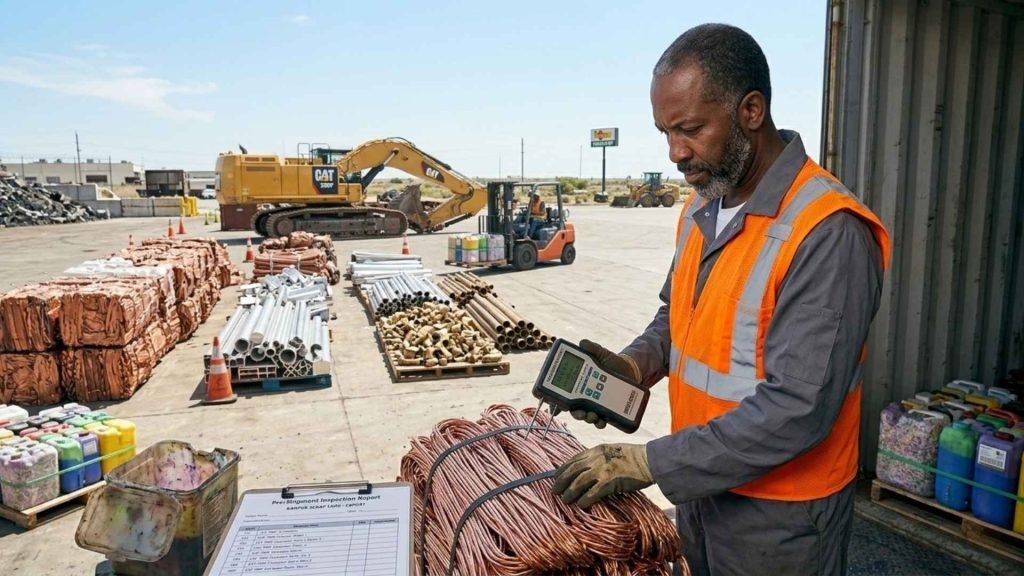
You’ve got 40 tons of mixed copper scrap sitting in your Toronto yard. Destination: India. Who do you call—a direct carrier or a ?
Most exporters get this wrong. They book directly with carriers thinking they’ll save money, then spend the next 90 days fighting demurrage charges, documentation holds, and rejected shipments.
Here’s the truth: direct carriers move containers. Scrap metal shipping companies solve problems. Knowing when you need which one can save you thousands—or cost you a fortune.
The Two Options Every Scrap Exporter Faces
| Service Type | What You Get | What You Don’t Get |
|---|---|---|
| Direct Carrier | • Port-to-port vessel movement • Ocean freight rate • Basic booking confirmation | • Inland trucking coordination • Documentation support • Container stuffing oversight • Customs compliance help |
| Scrap Metal Shipping Company | • Complete door-to-port logistics • Export documentation handling • Weight distribution planning • Compliance verification • Single point of contact | • Nothing—it’s a full-service solution |
Think of it this way: Direct carriers are like buying a plane ticket. Scrap metal shipping companies are like hiring a travel agent who books your flight, hotel, transfers, and handles your visa paperwork.
When Shipment Complexity Demands More Than Just a Carrier
Not all scrap shipments are created equal. Here’s when complexity makes direct carrier booking a mistake:
Multiple Handling Stages = Multiple Failure Points
Your scrap journey typically involves:
- Yard consolidation: Loading mixed scrap grades into containers
- Trucking to port: Coordinating pickup windows and delivery schedules
- Port handling: Terminal transfer, customs inspection, vessel loading
- Weight verification: Ensuring containers meet VGM requirements
Direct carriers only control one of these stages: vessel loading. If your container reaches the port above the allowed weight limit, resolving the issue becomes your responsibility, while port storage fees continue to add up.
Bulk vs. Containerized: The Decision Matrix
| Scrap Type | Recommended Method | Why |
|---|---|---|
| Loose shredded steel (low density) | Shipping Company | Needs expert weight distribution; high risk of container rejection if improperly loaded |
| Bundled copper wire (high value) | Shipping Company | Requires secure packaging, theft prevention, insurance coordination |
| Aluminum extrusion scrap (clean, sorted) | Direct Carrier (maybe) | Straightforward loading; lower complexity if you have internal logistics team |
| Mixed HMS 1&2 (bulk volume) | Shipping Company | Volume optimization critical; proper categorization prevents customs disputes |
Real Cost Example: A Toronto exporter tried DIY booking with a direct carrier for 3 containers of shredded aluminum. Result? Two containers rejected at port for improper weight distribution. Demurrage charges: $2,800. Re-stuffing costs: $1,200. Total avoidable expense: $4,000.
The Hidden Costs Direct Carriers Won’t Tell You About
Here’s where exporters lose money working with direct carriers:
Cost Comparison: DIY Direct Carrier vs. Scrap Metal Shipping Company
Data based on 2025-2026 GFFCA client shipment analysis across 400+ scrap metal exports
The math is brutal:
- Average demurrage charge per day: $120-180 per container
- Average delay with direct carrier (DIY): 7-12 days
- Cost per container: $840-2,160 in avoidable fees
- Documentation re-submission delays: Additional 3-5 days
A scrap metal shipping company eliminates these risks through proactive planning, proper documentation, and port relationship management.
When Documentation Gets Complicated (Hint: It Always Does)
Scrap metal isn’t widgets. Export regulations are complex, country-specific, and constantly changing.
Essential documents for metal scrap export:
Must match exact scrap grade classifications
Container-specific weight breakdowns required
HS codes must match destination country requirements
Needed for preferential tariff treatment
Often required by India, China, Middle East buyers
Mandatory for most ferrous scrap exports
Direct carriers provide: A booking number. That’s it.
Scrap metal shipping companies provide: Document preparation, compliance verification, and corrections before your shipment hits customs.
The Real-World Cost of Getting Documents Wrong
| Document Error | Average Cost Impact | Typical Delay |
|---|---|---|
| Incorrect HS code classification | $800-2,500 | 5-8 days |
| Missing radioactivity certificate | $1,200-3,000 | 7-14 days |
| Weight discrepancy (actual vs declared) | $500-1,500 | 3-5 days |
| Improper scrap grade description | $600-2,000 | 4-7 days |
When Destination Markets Are High-Risk
Shipping to India, China, or Thailand? These markets have strict import requirements for scrap metal that change regularly.
High-complexity destination checklist:
⚠️ Markets Requiring Scrap Metal Shipping Company Expertise:
- India: Pre-shipment inspection, SIMS grades documentation, radioactivity clearance
- China: AQSIQ registration, quality verification, contamination limits enforcement
- Middle East: Origin certification, quality attestation, potential re-inspection at destination
- Southeast Asia: Variable standards, frequent regulatory updates, local agent requirements
Direct carriers have zero expertise in these requirements. A scrap metal shipping company like GFFCA has boots-on-the-ground knowledge and established relationships in these markets.
Cost Optimization: Where Shipping Companies Actually Save You Money
Contrary to popular belief, working with a scrap metal shipping company often costs less than direct carrier booking once you factor in:
| Cost Factor | Direct Carrier (DIY) | Shipping Company | Your Savings |
|---|---|---|---|
| Ocean freight rate | $2,800 | $2,650 | -$150 |
| Inland trucking | $450 | $380 | -$70 |
| Documentation prep | $200 (DIY time) | Included | -$200 |
| Average demurrage risk | $1,200 | $180 | -$1,020 |
| Error correction costs | $600 | $50 | -$550 |
| TOTAL PER CONTAINER | $5,250 | $3,260 | -$1,990 |
Bottom line: A shipping company’s service fee is typically offset entirely by the costs they help you avoid.
When You Need Speed and Flexibility
Scrap markets move fast. Prices fluctuate. Buyers change requirements. Your logistics partner needs to adapt.
Scenarios where shipping company flexibility matters:
- Urgent shipments: Buyer needs material ASAP; requires expedited shipping coordination
- Volume spikes: You land a major contract and need to scale from 2 containers/month to 10 containers/month
- Route changes: Geopolitical issues (see our 2026 logistics strategy guide) force routing adjustments
- Multi-destination shipments: Same scrap batch going to India, Thailand, and China requires coordinated documentation
Direct carriers operate on fixed schedules with rigid processes. Scrap metal shipping companies build solutions around your needs, not their sailing schedule.
When Direct Carriers Might Actually Work
To be fair, there are situations where direct carrier booking makes sense:
✓ You Might Be Fine with Direct Carriers If:
- You have an experienced internal logistics team handling all documentation and compliance
- You’re shipping clean, sorted, single-grade scrap (e.g., pure copper wire, clean aluminum extrusion)
- You ship the same route repeatedly and have established relationships at origin and destination ports
- You’re comfortable managing demurrage risk, documentation errors, and port coordination yourself
- Your shipments are simple port-to-port with no inland trucking or complex handling
If you checked all five boxes above, congratulations—you’re the 8% of scrap exporters who can DIY this successfully.
For the other 92%? A scrap metal shipping company is the smarter choice.
The GFFCA Advantage: What Sets Us Apart
At GFFCA, we’ve handled metal scrap export Canada operations for over a decade. Here’s what we bring to the table:
🌍 Global Network
Established relationships in India, China, Thailand, Middle East, and beyond. We know the regulations, the inspectors, and the shortcuts.
📋 Documentation Mastery
We handle every form, certificate, and declaration required. Zero guesswork. Zero delays from paperwork errors.
⚖️ Weight Optimization
Our team plans container loading to maximize weight while staying within VGM limits. More scrap per container = lower cost per ton.
🛡️ Risk Management
Insurance coordination, quality checks, inspection management. We prevent problems instead of reacting to them.
Your Next Move
The choice between direct carriers and a scrap metal shipping company comes down to one question:
Do you want to move containers, or do you want to move scrap successfully?
If you’re serious about bulk scrap shipping and metal scrap export Canada operations that actually make money instead of bleeding it through delays and penalties, you need a logistics partner—not just a vessel booking.
Stop fighting demurrage charges and documentation disasters.
Get Your Scrap Metal Shipping Quote Now →
GFFCA: Your partner for scrap metal shipping company services that actually work.
