

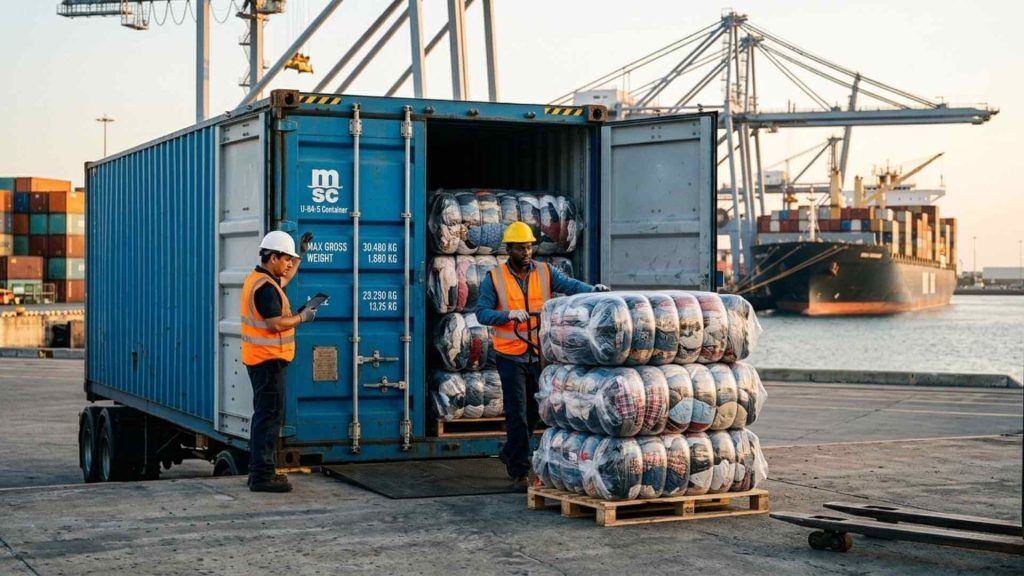
The global used clothing market is projected to hit $218 billion by 2026—and most of that value moves across international borders.
What was once a charity-driven afterthought is now a sophisticated export industry, and freight forwarding sits directly at the center of it.
As demand for used clothing exports surges across Africa, Southeast Asia, and the Middle East, the logistics complexity has evolved far beyond simple container shipments.
Today’s exporters need specialized freight forwarding expertise to navigate customs requirements, optimize container utilization, and manage the unique challenges of moving variable-grade textiles across continents.
The Growing Market for Used Clothing Exports
The used clothing exports industry has fundamentally transformed over the past five years. Retail-driven demand now dominates where charity-based distribution once led.
Gen Z buys more used clothes than new, platforms like Vinted and Depop process volumes rivaling traditional retailers, and international resale markets have matured dramatically.
Three regions are driving the majority of growth in 2026:
- Africa (West and East): Ghana, Kenya, Tanzania, and Uganda represent the largest destinations. Import volumes continue growing 8-12% annually as middle-class expansion fuels secondhand retail infrastructure.
- Southeast Asia: Vietnam, Thailand, and the Philippines are emerging markets with high-quality grading standards and growing consumer acceptance of premium vintage imports.
- Middle East: UAE and Saudi Arabia have developed sophisticated luxury resale markets, particularly for authenticated designer pieces. This segment moves primarily via air freight due to value density.
The shift from charity donations to commercial retail operations means exporters now face real-time inventory management, quality grading requirements, and delivery window expectations that traditional logistics couldn’t handle.
This is precisely where specialized used clothing export freight services become essential rather than optional.
Challenges in the Used Clothing Supply Chain
Moving used clothing exports across borders involves complexity that standard freight operations regularly underestimate. Unlike predictable manufacturing goods, textile shipments face unique obstacles:
Customs classification chaos. HS codes for used clothing vary by composition, garment type, and quality grade. Classification errors trigger customs delays, fines, and outright rejections. Kenya and Tanzania tightened import standards in late 2025, requiring phytosanitary certificates for certain textile categories—catching many exporters unprepared.
Consequently, the customs rejection rate for used clothing containers sits at approximately 6% industry-wide. That’s one in every 17 containers facing delays, re-inspection, or return to origin. Each incident costs $2,000-$5,000 in demurrage fees alone, not counting lost sales opportunities.
Quality grading disconnects. No universal standard exists for textile quality classification. One exporter’s “Grade A” is another buyer’s “mixed quality.” This triggers payment disputes—the #1 cause of logistics delays in this industry. Photographic documentation, sample bale verification, and written quality acceptance before shipping are now standard practices for successful exporters.
Seasonal timing disasters. Winter coats arriving in July face 40-60% price cuts. Ocean transit takes 30-45 days, plus 2-3 weeks for customs and inland delivery.
Working backward from peak selling seasons is critical—yet many exporters still ship reactively based on collection volume rather than destination market timing.
This is where strategic cross-docking and warehousing solutions create significant competitive advantage by decoupling collection timing from optimal shipment timing.
Why Freight Forwarders Are Key to Solving These Challenges
Specialized freight forwarders bring three capabilities that generic shipping brokers can’t replicate for used clothing exports:
Cross-border regulatory expertise. Navigating HS code classification, documentation requirements, and destination country import regulations requires specific knowledge of textile categories and quality standards.
Experienced freight forwarders maintain updated compliance documentation for major African, Asian, and Middle Eastern markets—preventing the 6% rejection rate that plagues inexperienced shippers.
Technology-enabled optimization. Modern freight forwarding platforms now integrate AI-driven container optimization, IoT shipment tracking, and blockchain documentation verification.
For used clothing specifically, this means better container utilization (maximizing the 20,000-24,000 lb capacity of a 40-foot container), real-time moisture monitoring during ocean transit, and automated customs documentation that reduces clearance time by 30-40%.
Moreover, technology enables coordinated inland logistics that connects collection points to consolidation facilities to port operations seamlessly—eliminating the communication gaps that cause delays.
Modal flexibility and speed. Not all used clothing exports move the same way.
Premium vintage items with immediate buyer commitments move via air freight (2-5 days, $2.40-$4.80/lb).
Bulk commercial shipments move via ocean freight (18-45 days, $0.18-$0.32/lb). Freight forwarders with access to both modes optimize based on value density, delivery urgency, and market timing—not just default to the cheapest option.
The Financial Benefits of Partnering with a Freight Forwarding Company
The cost difference between DIY shipping coordination and working with specialized freight forwarders typically ranges from 18-28% of total logistics spend. Here’s where that value comes from:
- Container consolidation and utilization. Proper baling compresses clothing to 0.7-0.9 lbs per cubic foot, maximizing container utilization. A $3,200 baling press pays for itself in 6-8 containers through improved density.
Freight forwarders coordinate this consolidation across multiple collection points—something individual exporters can’t achieve efficiently.
- Rate stability through volume commitments. Spot market ocean freight rates fluctuate 40-60% seasonally.
Freight forwarders with established carrier relationships lock in contracted rates 20-30% below spot market peaks. For exporters shipping 10+ containers annually, this stabilizes budgets and protects margins during Q3/Q4 demand surges.
- Scalability without capital investment. Demand for used clothing exports is volatile—collection volumes spike unpredictably, destination markets shift based on regulatory changes, and seasonal inventory can double or triple.
Freight forwarders provide the warehousing, transportation, and operational capacity to scale up or down without exporters investing in fixed infrastructure.
This flexibility is particularly valuable for operations processing 500,000+ lbs monthly where internal logistics infrastructure would require substantial capital.
Additionally, freight forwarders absorb the cost of technology platforms, compliance monitoring, and carrier relationship management—fixed costs that would otherwise fall on individual exporters at much higher per-unit expenses.
What Sets GFFCA Apart in the Used Clothing Export Freight Forwarding Space
The gap between “we ship textiles” and “we optimize used clothing exports for profitable international trade” is substantial. GFFCA’s specialized freight forwarding handles the complete complexity:
Textile-specific expertise. Understanding product categories, quality grades, destination market requirements, and seasonal timing opportunities means treating used clothing exports as the sophisticated supply chain they actually are—not as generic bulk freight.
Full modal flexibility. From expedited air freight for premium items to optimized ocean container service for bulk volumes, GFFCA provides the right solution for each shipment tier rather than forcing everything into a single mode.
Real-world results. A mid-sized used clothing exporter shipping to East Africa was experiencing 8-10% container rejection rates at Mombasa due to documentation inconsistencies.
After partnering with GFFCA for customs compliance review and HS code verification, rejection rates dropped to under 2% within three shipment cycles.
The operational cost savings from avoiding demurrage fees and re-shipment alone justified the freight forwarding partnership—before accounting for faster delivery times and improved buyer satisfaction.
Ready to Optimize Your Used Clothing Export Logistics in 2026?
The global used clothing trade moved 4.8 million metric tons in 2025. Every pound required sophisticated logistics to navigate collection, grading, customs, shipping, and final delivery.
The exporters winning in 2026 treat this like the complex international supply chain it is—and they work with freight forwarding partners who do the same.
Whether you’re shipping your first container or scaling to multi-market distribution, specialized used clothing export services handle the complexity so you can focus on sourcing and selling.
The used clothing export industry is projected to reach $218 billion by 2026. The freight forwarders who understand textile logistics complexity—not just container shipping—are capturing the majority of that growth.

