

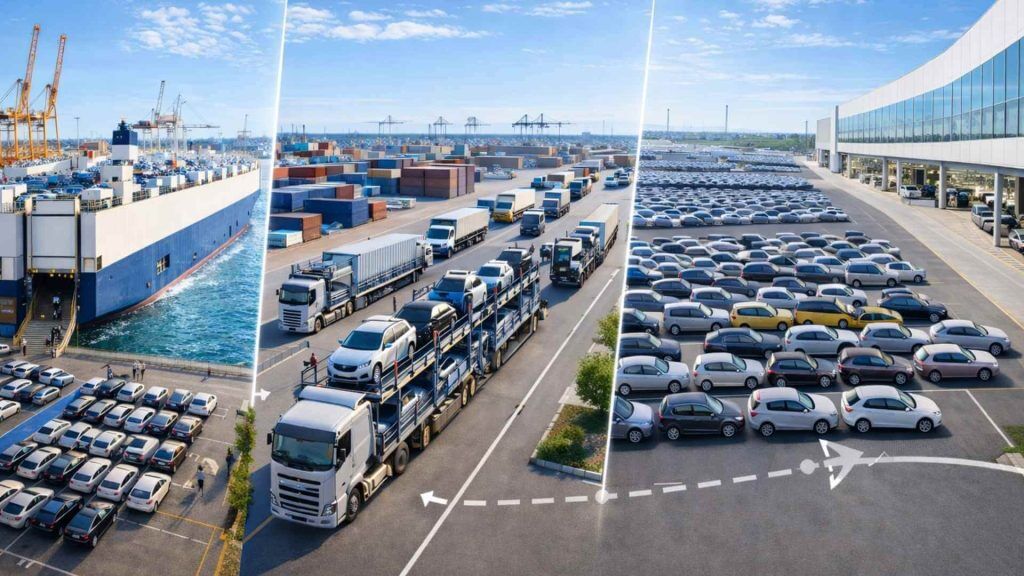
Global automobile logistics runs on precision timelines—vehicles built in Mexico, shipped through Belgium, delivered to Saudi Arabia within 28 days.
But geopolitical conflicts can disrupt vehicle exports overnight, turning predictable supply chains into daily crisis management.
The reality of 2026? Automobile logistics depends on stable global trade routes, functional ports, and open shipping lanes. Red Sea attacks. Black Sea port closures.
Taiwan Strait tensions. Each conflict doesn’t just delay shipments—it forces freight forwarders to re-engineer entire logistics networks in real time while OEMs watch dealership inventory drain and production schedules collapse.
This isn’t theoretical supply chain risk. It’s operational reality for every automotive shipping operation moving vehicles internationally in 2026.
Why Automobile Logistics Is Uniquely Conflict-Sensitive
Unlike bulk commodities that can wait in floating storage or be diverted without time pressure, automobile logistics operates under constraints that make geopolitical disruptions particularly damaging.
Five factors create this vulnerability:
- High-value, time-sensitive cargo. A single RoRo vessel carries $150-$300 million in vehicle inventory. Delays don’t just postpone delivery—they tie up capital, trigger financing penalties, and create dealership shortages that compound weekly.
- Dependence on specific shipping lanes. The Suez Canal, Red Sea, Black Sea, and Taiwan Strait aren’t optional routes with easy alternatives—they’re foundational arteries that automobile logistics relies on. When any of these close or become high-risk, rerouting adds 10-20 days and 15-35% to freight costs.
- OEM production tied to delivery schedules. Modern automotive manufacturing operates on lean inventory principles. When export shipments delay, production lines adjust, supply chains recalibrate, and the ripple effects cascade through quarters, not just weeks.
- Port congestion impacts dealership inventory. A conflict-driven port closure in one region creates congestion at alternative ports globally. Vehicles sit in compounds, dealers run low on inventory, and customer orders convert to cancellations when delivery windows miss by months.
- Export financing and trade credit risks. Banks and trade finance institutions increase collateral requirements, reduce credit lines, and add risk premiums when geopolitical instability threatens repayment timelines. The financial cost of conflict extends beyond freight rates.
- Key insight: Even short conflicts create long logistics ripple effects. A 14-day Red Sea disruption in late 2025 created port congestion that persisted for 8 weeks across three continents.
Major Conflict Zones Disrupting Automobile Logistics Right Now
Red Sea / Suez Canal Disruptions
Since late 2023, attacks on commercial vessels transiting the Red Sea forced carriers to reroute around Africa’s Cape of Good Hope. For automobile logistics, this means:
- Transit times from Asia to Europe increased by 10-15 days
- Transit costs jumped 20-30% due to additional fuel and crew expenses
- RoRo vessel capacity tightened as longer routes reduced fleet availability
- Insurance war-risk premiums added $50,000-$150,000 per vessel
Russia-Ukraine Conflict
Black Sea port closures, rail corridor disruptions into Europe, and sanctions compliance created a multi-layered crisis for European automotive exports.
Ukraine’s pre-war role as a logistics corridor for Central and Eastern Europe vanished overnight.
Romanian and Bulgarian ports absorbed overflow, but lacked the infrastructure capacity, creating bottlenecks that persisted through 2024-2025.
US-China Trade Tensions
Tariffs on vehicle imports/exports, supply chain diversification mandates, and increased compliance documentation slowed cross-Pacific automobile logistics.
Chinese EV exports to North America face enhanced scrutiny. U.S. vehicle exports to China encounter reciprocal barriers.
The result?
Longer customs clearance times, higher compliance costs, and unpredictable policy shifts that make long-term logistics planning nearly impossible.
Middle East Instability
Beyond direct conflict zones, Middle East instability drives oil price volatility, which directly impacts bunker fuel costs for ocean freight. Consequently, freight rates fluctuate weekly rather than quarterly, making budgeting and contract pricing difficult for automotive OEMs.
Additionally, escort requirements for vessels transiting certain waters add operational delays and security costs.
What Freight Forwarders Face During Geopolitical Crises
When conflicts escalate, automobile logistics shifts from scheduled operations to reactive crisis management. Here’s what changes operationally:
- Vessel schedule cancellations and blank sailings. Carriers cancel scheduled sailings or skip entire ports (blank sailings) to avoid risk zones or consolidate cargo on fewer vessels. For shippers with booked capacity, this means scrambling for alternative vessels—often at premium spot rates.
- Emergency port diversions. Vessels redirect mid-voyage to alternative ports when original destinations become inaccessible. A RoRo ship headed to Odessa diverts to Constanta. Vehicles meant for one dealer network now need overland transport from an unplanned location.
- Documentation changes due to sanctions. Trade sanctions require immediate adjustments to bills of lading, customs documentation, and financing paperwork. A vehicle shipment cleared for export on Monday may be non-compliant by Friday if sanctions expand.
- Increased cargo inspection and clearance delays. Customs authorities in conflict-adjacent regions intensify inspections, looking for sanctioned goods, dual-use technology, or compliance gaps. What normally clears in 2-3 days can extend to 2-3 weeks.
- Operational reality: Freight planning shifts from weekly scheduling to daily crisis management. The logistics teams handling automobile logistics in 2026 operate more like emergency response coordinators than traditional schedulers.
The Real Cost Impact: 15-35% Freight Increases
Geopolitical conflicts don’t just delay shipments—they fundamentally alter the cost structure of automobile logistics.
Cost breakdown during conflict escalations:
- War risk insurance surcharges: $50,000-$150,000 per vessel transiting high-risk zones. This wasn’t a line item in pre-2023 budgets—it’s now standard.
- Fuel price spikes: Middle East instability drives bunker fuel volatility. Prices can swing 15-25% in a month, and fuel surcharges pass directly to shippers.
- Charter vessel rate increases: When scheduled capacity disappears, shippers turn to charter vessels at spot rates—often 40-60% above contract pricing.
- Escort and security costs: Some shipping lanes now require naval escort or private security—adding $25,000-$75,000 per voyage.
- Emergency warehousing charges: Diverted cargo needs storage while rerouting logistics get arranged. Compound storage in unplanned locations costs 2-3x normal rates.
- Detention and demurrage fees: Port congestion at alternative hubs means containers and RoRo slots sit longer than planned—triggering daily fees of $100-$500 per unit.
- Bottom line: A single geopolitical escalation can increase automobile freight costs by 15-35%. For OEMs moving 100,000+ units annually, that’s tens of millions in unbudgeted expenses.
Transit Times: When 28 Days Becomes 50
Extended ocean transit timelines, port congestion at alternative hubs, and inland trucking bottlenecks combine to stretch delivery windows beyond recognition. A shipment from South Korea to Germany that took 28 days via Suez now takes 45-50 days via Cape of Good Hope.
The impact cascades: Dealership inventory shortages lead to lost sales, OEM production slowdowns create supplier cash flow problems, and customer orders convert to cancellations when delivery dates slip by months.
Missed export delivery windows can delay vehicle launches globally. A new model launch planned for Q2 with vehicles shipping in Q1 misses the market entirely if geopolitical disruptions add 6-8 weeks to logistics timelines. Competitors fill the gap. Marketing campaigns run without inventory. Launch momentum evaporates.
Moreover, technology integration is becoming essential. As detailed in our recent analysis of how AI is revolutionizing automobile logistics, predictive rerouting and real-time visibility tools are now critical for managing geopolitical disruption—not optional enhancements.
Compliance Nightmares: When Rules Change Overnight
Geopolitical conflicts trigger immediate regulatory changes that automobile logistics operators must navigate in real time:
- Trade sanctions affecting vehicle exports — A country added to sanctions lists makes any in-transit vehicles to that destination immediately non-compliant
- Restricted ports and trade lanes — Insurance underwriters declare certain ports off-limits; cargo booked for those destinations needs emergency rerouting
- Dual-use goods classification risks — Vehicles with advanced technology (radar, GPS, communications) face export restrictions if they could have military applications
- EV battery export restrictions — Lithium-ion battery regulations tighten during conflicts due to strategic material concerns
- Documentation audits — Customs authorities require enhanced proof of origin, component sourcing, and end-user declarations
Freight forwarders must track regulatory updates in real time—monitoring government announcements, trade bulletins, and sanctions lists daily rather than monthly. One missed update can halt an entire shipment at customs for weeks.
Risk Mitigation: Building Conflict-Ready Logistics
Smart automobile logistics operators aren’t waiting for conflicts to resolve—they’re building resilience into their networks proactively.
Multi-port export planning. Instead of single-port dependency, diversify across 2-3 viable ports per region. If primary routes close, alternatives exist without starting contingency planning from scratch.
Alternative trade lane mapping. Maintain updated transit plans for both primary and secondary routes—including realistic cost and time assessments so decisions can be made within hours, not days.
RoRo vs container switching flexibility. Some routes work better on containers when RoRo capacity tightens. Having both options pre-negotiated provides operational flexibility during crises.
Inventory buffer storage. Strategic warehousing near key ports enables holding inventory during transit disruptions without production line impacts. This costs money—but less than emergency rerouting or production shutdowns.
Flexible freight booking contracts. Force majeure clauses, rebooking rights, and carrier substitution provisions written into contracts before conflicts arise provide legal protection during disruptions.
Insurance upgrades. War risk, terrorism, and political violence coverage aren’t standard in basic marine insurance. Upgrade policies before entering high-risk regions, not after incidents occur.
This positions freight forwarders as strategic partners rather than transactional shippers. The value isn’t just moving vehicles—it’s maintaining continuity when disruption is the default state.
The Freight Forwarder as Crisis Navigator
When geopolitical conflicts disrupt automobile logistics, freight forwarders transition from logistics coordinators to crisis navigators—a distinction that matters operationally.
What this looks like in practice:
- Real-time route re-engineering. Monitoring conflict zones, weather, port congestion, and capacity constraints continuously—then rerouting shipments proactively before disruptions force reactive scrambling.
- Vessel rebooking and chartering. When scheduled capacity disappears, forwarders with carrier relationships and market knowledge secure alternative vessels. Shippers without that network pay spot market premiums—or wait.
- Customs and sanctions compliance. Tracking regulatory changes across jurisdictions, updating documentation preemptively, and clearing shipments through evolving requirements without delays.
- Risk advisory for OEM exporters. Providing geopolitical risk assessments, alternative routing recommendations, and cost-benefit analyses so OEMs make informed decisions rather than guessing.
- Emergency warehousing coordination. Securing storage at unplanned locations when diversions occur, managing inventory during transit delays, and coordinating onward movement when routes reopen.
- End-to-end shipment visibility. Real-time tracking of vehicle shipments across ocean, port, and inland phases so OEMs and dealers have accurate ETAs despite route changes.
Working with an experienced freight forwarding partner provides this operational capability—something internal logistics teams typically can’t replicate without significant infrastructure investment.
Future Outlook: Adaptation as the New Normal
- Trade lane diversification trends. OEMs are expanding manufacturing footprints to reduce single-route dependency. Mexico for North America, Eastern Europe for EU, Southeast Asia for regional markets.
- Nearshoring and regional manufacturing. The days of shipping every vehicle across oceans are ending. Regional production hubs shorten supply chains and reduce geopolitical exposure—though they don’t eliminate it.
- Strategic port partnerships. Long-term agreements with multiple ports across regions provide guaranteed capacity and priority handling during disruptions. This requires capital commitment but creates competitive advantage.
- AI-based geopolitical risk forecasting. Predictive analytics tracking political developments, conflict escalation patterns, and trade policy shifts enable proactive logistics adjustments rather than reactive firefighting.
- Increased reliance on specialized freight forwarders. As complexity increases, OEMs are consolidating automobile logistics with partners who have global networks, carrier relationships, compliance expertise, and crisis management infrastructure. The era of managing this internally is ending for all but the largest manufacturers.
Partner With GFFCA to Navigate Complex Automobile Logistics
Geopolitical conflicts are unavoidable in 2026. But their impact on your automobile logistics operations doesn’t have to be catastrophic. The difference between continuity and crisis often comes down to one factor: working with freight forwarding partners who have the global networks, carrier relationships, and crisis management expertise to navigate disruption as standard operating procedure.
GFFCA specializes in automotive shipping across conflict-affected regions, providing:
- RoRo and container automobile shipping solutions across multiple trade lanes
- Conflict-zone route planning and real-time rerouting capability
- Customs and sanctions compliance management across jurisdictions
- Multi-country logistics coordination with end-to-end visibility
- Emergency warehousing and inventory management during disruptions
From domestic distribution via reliable trucking solutions to international ocean freight and complex cross-border coordination, GFFCA manages the full spectrum of automobile logistics challenges.
Get a quote for conflict-ready automobile logistics solutions →
In volatile trade environments, logistics resilience becomes a competitive advantage. The OEMs maintaining delivery schedules while competitors face delays aren’t lucky—they’re working with freight forwarders who treat geopolitical complexity as the baseline, not the exception.

