

International Vehicle Shipping
Car Shipping from Canada to Switzerland: Costs, Methods and Import Rules
Learn how car shipping from Canada to Switzerland works, including RoRo and container options, European port routing, Swiss customs, taxes, relocation rules, documents, and vehicle registration.
Shipping a car from Canada to Switzerland requires more planning than shipping to many coastal European destinations.
Because Switzerland is landlocked, the vehicle normally travels by ocean freight from Canada to a European seaport. From there, it continues inland toward Switzerland.
Therefore, the complete transportation plan needs to account for much more than the ocean voyage.
Canadian export documentation, European port handling, inland transportation, Swiss customs clearance, import taxes, technical requirements, and vehicle registration can all affect the final cost and timeline.
Whether you are relocating to Switzerland, purchasing a vehicle in Canada, exporting a classic car, or moving a personally owned vehicle overseas, planning each stage before departure can help reduce delays and unexpected expenses.
GFFCA’s international car shipping services can help coordinate vehicle transportation from Canada to overseas destinations.
Key Takeaways
- Switzerland is landlocked, so vehicle shipping normally combines ocean freight with inland transportation.
- RoRo may suit standard running vehicles, while container shipping can provide greater flexibility for classic, luxury, modified, or certain non-running cars.
- Canadian export reporting and accurate VIN documentation should be completed before departure.
- Swiss vehicle imports may involve automobile tax, VAT, and additional CO₂-related requirements.
- People relocating to Switzerland may qualify for household-effects relief when the applicable conditions are met.
- Customs clearance does not automatically make a Canadian vehicle road-legal in Switzerland.
How Does Car Shipping from Canada to Switzerland Work?
A Canada-to-Switzerland vehicle shipment usually involves several connected transportation stages.
The process may include:
- Vehicle pickup in Canada
- Transportation to the export warehouse or port
- Canadian export documentation
- RoRo or container loading
- Ocean transportation to a European port
- Port handling and vehicle release
- Inland transportation toward Switzerland
- Swiss customs clearance
- Technical inspection and registration
- Final delivery or vehicle pickup
Since Switzerland does not have a deep-sea ocean port, the shipping route must combine ocean and inland transportation.
For that reason, comparing only the ocean freight rate does not provide an accurate picture of the complete transportation cost.
GFFCA’s inland transportation solutions can help coordinate Canadian pickup, port transportation, and related inland stages.
RoRo vs. Container Shipping to Switzerland
The two main methods for shipping a car overseas are RoRo and container shipping.
The better option depends on the vehicle’s value, condition, dimensions, route, and required level of protection.
RoRo Car Shipping
RoRo stands for roll-on/roll-off.
The vehicle is driven onto a specialized vessel, secured during the ocean voyage, and driven off again at the destination terminal.
RoRo may work well for a standard vehicle in reliable operating condition.
Generally, the vehicle should:
- Start reliably
- Move forward and backward
- Steer correctly
- Brake safely
- Have properly inflated tires
- Have no major fluid leaks
RoRo can provide a straightforward option when a suitable service connects the Canadian export route with a European port that supports onward transportation to Switzerland.
However, availability depends on the carrier, departure port, destination terminal, and vessel schedule.
Container Car Shipping
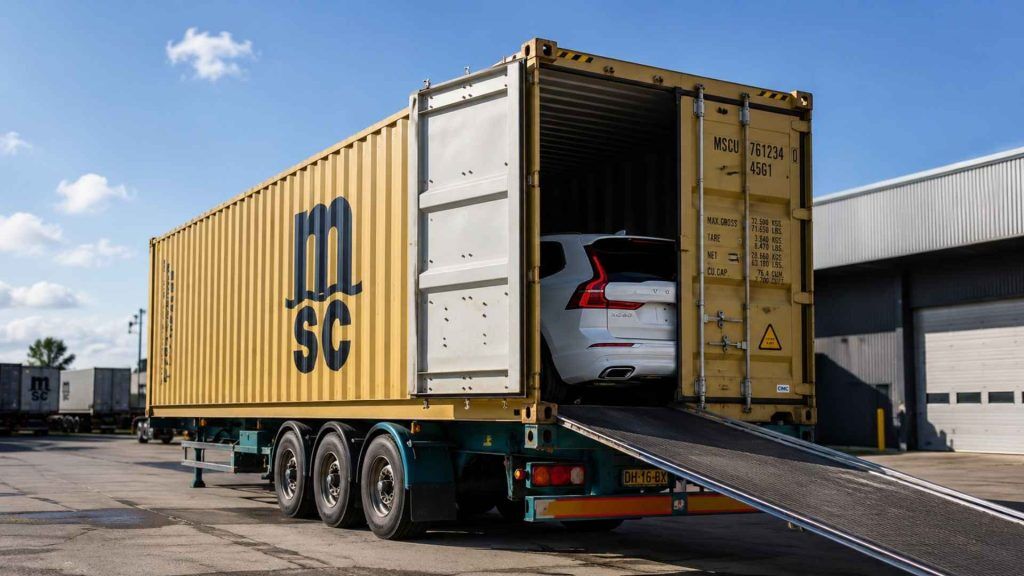
With container shipping, the vehicle is loaded and secured inside a shipping container.
This option may be more suitable for:
- Classic cars
- Collector vehicles
- Luxury cars
- High-value vehicles
- Modified cars
- Certain non-running vehicles
- Vehicles requiring more controlled loading
A 20-foot container may accommodate a single standard vehicle, while other container arrangements may support larger vehicles or additional approved cargo.
In every case, the vehicle must be properly blocked and secured before transportation.
Customers considering dedicated container transportation can review GFFCA’s FCL shipping from Canada services.
Which Method Should You Choose?
RoRo: Often suitable for standard running vehicles when a suitable sailing and European gateway are available.
Container: Often preferred for classic, luxury, modified, high-value, or certain non-running vehicles that need more controlled loading.
How Much Does It Cost to Ship a Car from Canada to Switzerland?
There is no fixed rate for every Canada-to-Switzerland vehicle shipment.
Instead, pricing depends on the vehicle and the complete transportation route.
Important cost factors include:
- Canadian pickup city
- Export port
- Vehicle dimensions
- Vehicle weight
- Running or non-running condition
- RoRo or container shipping
- Container loading and securing
- Ocean freight
- European arrival port
- Port handling
- Inland transportation into Switzerland
- Swiss customs clearance
- Import taxes
- Final delivery location
- Storage when applicable
For example, transporting a standard sedan from a major Canadian city will require a different plan from moving a large pickup truck from a remote location.
Similarly, a non-running vehicle may require a winch, tow truck, forklift, or other specialized loading equipment.
Therefore, when requesting a quote, provide:
- Year
- Make
- Model
- VIN
- Vehicle condition
- Canadian pickup location
- Final destination in Switzerland
Accurate information allows the freight forwarder to select suitable equipment and routing.
What Documents Do You Need?
Vehicle documentation should be prepared before the car reaches the export terminal.
Common documents may include:
- Canadian vehicle ownership or registration
- Bill of sale or commercial invoice
- Vehicle Identification Number
- Passport or identification
- Shipping instructions
- Canadian export declaration
- Bill of Lading
- Swiss customs declaration
- Proof of vehicle value
- Relocation documents when applicable
Pay particular attention to the VIN.
The VIN should match across the ownership document, invoice, export declaration, shipping instructions, and Bill of Lading.
Even a small discrepancy can delay the shipment or customs process.
Check the VIN Before Shipping
Compare the VIN on the physical vehicle with the ownership document, bill of sale, export declaration, shipping instructions, and Bill of Lading before submission. Correcting discrepancies before departure is much easier than resolving them after the vehicle reaches Europe.
What Are the Canadian Export Requirements?
A permanently exported vehicle travelling from Canada to Switzerland may need to be reported through Canada’s applicable export-reporting process.
Where required, the export declaration should include the vehicle identification number.
CERS, the Canadian Export Reporting System, is commonly used to submit applicable export information electronically.
Therefore, exporters should complete the required export declaration and proof of report within the applicable timeframe before the vehicle leaves Canada.
GFFCA’s customs brokerage services may support qualifying documentation and customs-related requirements.
What Happens at Swiss Customs?
A vehicle being permanently imported into Switzerland must go through Swiss customs clearance.
The process may require:
- Invoice or purchase contract
- Foreign vehicle registration document
- Proof of identity
- Import customs declaration
After customs clearance, Swiss Customs may issue Form 13.20 A, which forms part of the subsequent Swiss vehicle-registration process.
Customs clearance and road registration are related, but they are not the same process.
Therefore, the vehicle must still satisfy the applicable registration and technical requirements before regular road use.
What Taxes Apply When Importing a Car?
The supplied guidance identifies two important charges that owners should consider when importing a vehicle into Switzerland. :contentReference[oaicite:1]{index=1}
Swiss Automobile Tax
Passenger vehicles and certain light commercial vehicles may generally face a 4% automobile tax based on the applicable vehicle value.
This charge should be considered separately from the ocean freight, European port handling, and inland transportation costs.
Swiss VAT
The supplied material identifies an 8.1% Swiss import VAT rate for vehicle imports.
The VAT calculation may include more than the purchase price of the vehicle.
Depending on the customs valuation, transportation and other applicable charges can form part of the assessment.
Therefore, keep the purchase invoice or sales contract available to support the declared vehicle value.
Could Swiss CO₂ Rules Apply?
Certain vehicles may also face Swiss CO₂ requirements before first registration.
The exact treatment can depend on:
- Vehicle age
- First-registration date
- Mileage
- Technical specifications
- Previous foreign registration history
According to the supplied information, some previously registered vehicles may fall outside the CO₂ process depending on how long they have been registered abroad and their mileage. :contentReference[oaicite:2]{index=2}
Therefore, owners of newer vehicles should check the requirements for the specific vehicle before booking transportation.
Moving to Switzerland With a Car You Already Own
Relocating permanently to Switzerland can create a different customs situation from purchasing a vehicle specifically for import.
Qualifying household effects, including a personally owned car, may receive tax and duty relief when the owner transfers domicile to Switzerland.
A key condition identified in the supplied material is prior personal use. Generally, the owner should have used the vehicle abroad for at least six months before the move and should continue using it after import.
The relocation procedure may involve:
- Transfer of domicile
- At least six months of prior personal use
- Continued personal use after import
- Form 18.44
- Supporting relocation documents
- Customs declaration when entering Switzerland
However, moving to Switzerland does not automatically make every vehicle import tax-free.
The owner must satisfy the applicable requirements.
People relocating with furniture and personal effects can also review GFFCA’s household goods shipping from Canada guide.
What If You Have Owned the Vehicle for Less Than Six Months?
The situation may be different when the owner has used the vehicle abroad for less than six months before relocating.
According to the supplied material, the standard household-effects relief may not apply in the same way.
In certain circumstances, Swiss customs procedures may allow temporary use through another customs arrangement.
Because this depends heavily on the individual relocation circumstances, confirm the procedure before the vehicle reaches Switzerland.
Do not purchase a vehicle shortly before relocating and assume it will automatically receive the same treatment as a car you have owned and used for a longer period.
Can a Canadian Vehicle Be Registered in Switzerland?
Customs clearance does not automatically make a Canadian vehicle road-legal in Switzerland.
After clearing customs, the vehicle must complete the applicable cantonal registration process.
Swiss registration authorities may review:
- Type approval
- Vehicle construction
- Emissions
- Noise
- Lighting
- Safety equipment
- Technical specifications
This is particularly important for vehicles built specifically for the Canadian market.
A Canadian-specification model may differ from the equivalent European-market version.
As a result, additional technical documentation or vehicle modifications may be necessary.
Before paying for international transportation, confirm that the specific year, make, model, and configuration can satisfy Swiss registration requirements.
How Should You Prepare the Car for Shipping?
Proper preparation makes terminal and warehouse handling easier.
Before handing over the vehicle:
- Remove personal valuables
- Photograph all sides of the vehicle
- Photograph existing scratches or damage
- Record the mileage
- Check tire pressure
- Check the battery
- Test the brakes
- Check for fluid leaks
- Remove loose accessories
- Disable alarms when instructed
- Provide the required keys
- Follow the carrier’s fuel-level rules
If the vehicle does not run, disclose that before booking.
A non-running car may require different loading equipment and transportation arrangements.
Waiting until the vehicle reaches the terminal to explain that it cannot start, steer, or brake can create delays and additional charges.
Can You Leave Personal Belongings Inside the Car?
Do not automatically assume that personal goods can remain inside the vehicle.
RoRo carriers may prohibit or restrict personal belongings.
Container shipping can provide greater flexibility in some situations. However, household goods must still comply with:
- Carrier rules
- Canadian export requirements
- Customs requirements
- Destination-country regulations
If you plan to move a car and household goods together, confirm the arrangement before packing.
For larger relocation shipments, GFFCA’s international moving checklist can help organize household goods, documents, shipping, customs, and delivery requirements.
Common Mistakes When Shipping a Car to Switzerland
Using Estimated Vehicle Information
Provide the exact year, make, model, dimensions, VIN, and operating condition whenever possible.
Accurate information helps the transportation provider choose the correct equipment and route.
Ignoring Swiss Registration Requirements
A vehicle can successfully clear customs yet still face difficulties during technical approval or registration.
Therefore, check compatibility before shipping.
Forgetting the Inland Transportation Stage
The shipment does not end when the vessel reaches Europe.
You still need to move the vehicle from the European port into Switzerland.
Providing the Wrong VIN
Compare the VIN on the physical vehicle with every shipping and ownership document.
A discrepancy can affect export documents, the Bill of Lading, customs clearance, and registration.
Assuming Relocation Means Automatic Tax-Free Import
Prior ownership, personal use, transfer of domicile, and other requirements can determine eligibility.
Review these requirements before departure.
Comparing Only Ocean Freight Rates
Calculate the complete cost from Canadian pickup through European port handling, inland transportation, Swiss customs, and final delivery.
Car Shipping from Canada to Switzerland Checklist
- Confirm the vehicle year, make, and model
- Verify the correct VIN
- Prepare ownership documents
- Prepare the bill of sale or invoice
- Confirm running or non-running condition
- Confirm the Canadian pickup location
- Select RoRo or container shipping
- Review Canadian export requirements
- Confirm the European arrival route
- Arrange inland transportation to Switzerland
- Review Swiss customs requirements
- Calculate automobile tax and VAT exposure
- Confirm relocation exemption eligibility when applicable
- Review CO₂ requirements
- Confirm Swiss technical and registration requirements
- Arrange final delivery
Frequently Asked Questions
Can I Ship a Car from Canada to Switzerland?
Yes.
Vehicles can move from Canada to Switzerland when the applicable Canadian export, transportation, Swiss customs, and registration requirements are completed.
Does Switzerland Have an Ocean Port?
No.
Switzerland is landlocked. Therefore, the ocean portion of the journey normally ends at a European port before the vehicle continues inland into Switzerland.
How Much Tax Applies When Importing a Car?
The supplied material identifies a general 4% automobile tax for applicable passenger and light commercial vehicles and an 8.1% import VAT rate.
The actual assessment depends on the vehicle, customs value, and applicable import procedure.
Can I Bring My Car When Moving to Switzerland?
Potentially.
A qualifying personally owned vehicle may receive household-effects treatment when the relocation conditions are satisfied, including applicable prior-use requirements.
Do I Need CERS?
For applicable permanent exports from Canada, the vehicle may need to be reported through the Canadian export-reporting process.
Where required, the VIN should be included in the export information.
Can a Canadian-Specification Vehicle Be Registered in Switzerland?
Possibly, but approval depends on the specific vehicle.
Technical requirements involving emissions, equipment, construction, noise, lighting, or type approval may need to be addressed before registration.
Final Thoughts on Car Shipping from Canada to Switzerland
Car shipping from Canada to Switzerland requires coordination on both sides of the Atlantic.
The transportation plan needs to cover Canadian pickup, export documentation, RoRo or container shipping, the European port connection, inland transportation, Swiss customs clearance, taxes, technical requirements, and registration.
For most vehicle owners, one of the most important steps is checking Swiss import and registration requirements before the car leaves Canada.
This becomes even more important for Canadian-market vehicles, newer cars that may face additional CO₂ requirements, and vehicles moving as part of an international relocation.
With the vehicle details, documents, shipping method, customs treatment, and inland movement confirmed in advance, the shipment becomes much easier to manage.
Customers comparing other European routes can also read GFFCA’s guides for car shipping from Canada to Belgium, car shipping from Canada to Italy, car shipping from Canada to Spain, car shipping from Canada to Ireland, and car shipping from Canada to the UK.
Planning to Ship a Car to Switzerland?
Share the vehicle year, make, model, VIN, operating condition, Canadian pickup location, Swiss destination, and preferred shipping timeline for a customized transportation plan.
